
The Department of Education (DepEd) is set to implement a significant change in the way the Philippine school year is organized, with a three-term school calendar taking effect in School Year 2026–2027.
The reform is designed to address persistent problems in basic education, particularly the loss of instructional time, the heavy administrative burden on teachers, and the need to improve learning recovery after years of disruption.
DepEd Secretary Sonny Angara said the redesigned calendar aims to give teachers clearer boundaries between classroom teaching and non-teaching responsibilities, such as grading, preparing report cards, checking school forms, and attending conferences or training. By separating these duties into designated blocks, the department hopes teachers can concentrate more fully on lesson delivery during teaching periods.
DepEd clarified that the proposal is not a trimester system similar to those used in colleges and universities. Rather, it is a restructuring of the school calendar intended to make better use of time within the existing basic education framework.
DepEd’s Three-Term School Calendar
The school year will be divided into three terms, each made up of clearly defined blocks:
Opening Block
This covers the beginning-of-school-year activities and will appear only in Term 1. DepEd said this block will last five days.
Instructional Block
This is the protected period for teaching and learning, with minimal interruption from non-academic activities. Depending on the term, the instructional block will run from 54 to 61 days.
End-of-Term Block
This period, which will last six to 10 days, is intended for grading, preparation and checking of school forms, parent-teacher conferences, report card distribution, remediation or enrichment activities, in-service training for teachers, wellness breaks, and co-curricular or extra-curricular activities.
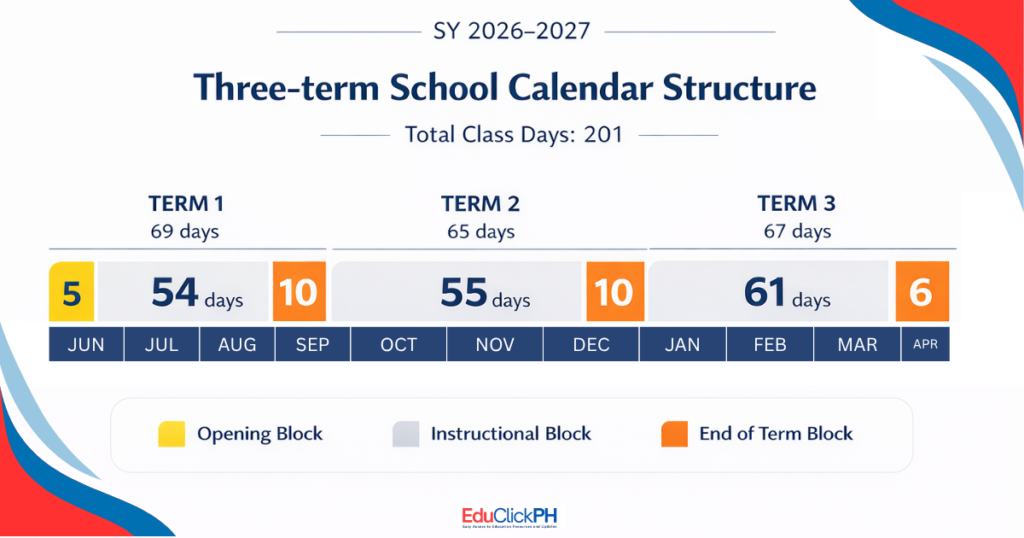
Based on DepEd’s proposed structure for SY 2026–2027, the calendar will have a total of 201 class days spread across three terms:
- Term 1: 69 days
- Term 2: 65 days
- Term 3: 67 days
Term 1 will include the five-day opening block, a 54-day instructional block, and a 10-day end-of-term block.
Term 2 will have a 55-day instructional block and a 10-day end-of-term block.
Term 3 will consist of a 61-day instructional block and a six-day end-of-term block.
What makes this different from the current system
Under the current school calendar, teaching time is often interrupted by activities that are not directly related to classroom instruction. Teachers may have to juggle lessons while also handling paperwork, reporting requirements, and school events within the same stretch of time.
DepEd said the proposed setup is meant to correct that by protecting instructional time and assigning administrative and school-wide tasks to separate periods.
In effect, the new structure seeks to make the school year more predictable for both teachers and students. Instead of having non-teaching duties spill into regular class days, the calendar is designed so that each part of the school year has a distinct purpose.

Would it mean that no urgent online reports in any form from the CO, RO, and DO are required from the teachers during the INSTRUCTIONAL BLOCK?
Good day, Ma’am Evelina!
No, not in the absolute sense. The instructional block is intended to protect uninterrupted teaching time and minimize non-academic interruptions. Routine reportorial requirements should therefore be reduced and aligned to designated schedules, with many administrative tasks shifted to the enrichment block. But this does not automatically mean that all urgent reports from the CO, RO, or DO are completely prohibited during the instructional block, unless a specific DepEd issuance expressly says so.