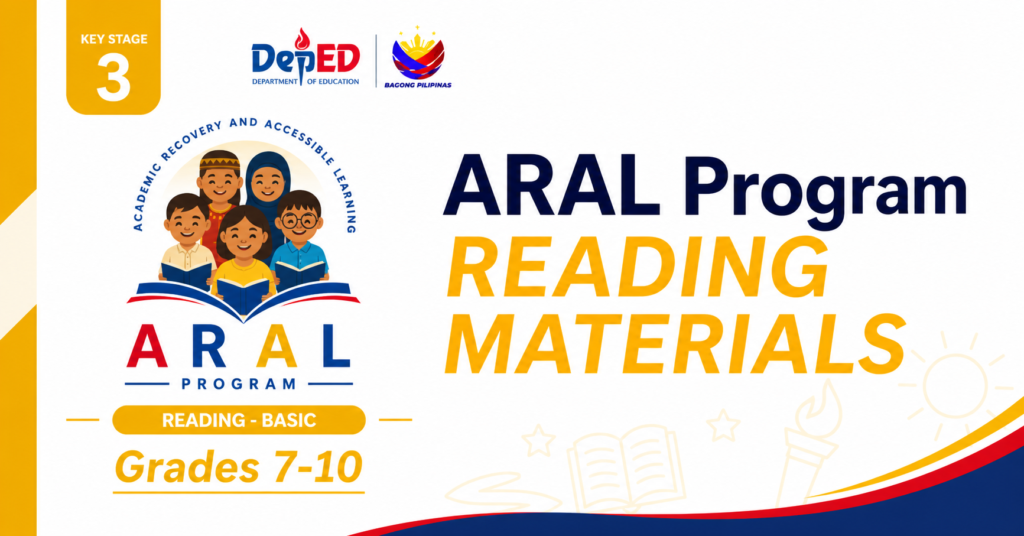
The ARAL Program Reading Materials for Key Stage 3 are designed to help learners transition from basic comprehension to advanced reading and critical thinking skills. Developed by the Department of Education (DepEd), this stage focuses on students in Grades 7–10 who need structured support in understanding complex texts.
According to the Key Stage 3 learning materials , learners are exposed to a variety of literary and informational texts. As a result, they develop deeper comprehension, analytical thinking, and interpretation skills.
Because of this structured approach, students become more confident readers and thinkers.
What is ARAL Reading Plus for Key Stage 3?
The Reading Plus component for Key Stage 3 goes beyond basic reading. At this level, learners are trained to:
- Analyze texts critically
- Interpret meanings (literal and implied)
- Evaluate ideas and messages
- Connect texts to real-life experiences
Therefore, reading becomes not just a skill—but a tool for understanding the world.
Key Features of Key Stage 3 Reading Materials
1. Exposure to Diverse Texts
Learners read a wide range of texts, including:
- Philippine epics (e.g., Biag ni Lam-ang)
- Folktales and legends
- Informational passages
- Literary excerpts
For example, the story of Indarapatra and Sulayman teaches values such as courage, sacrifice, and brotherhood .
2. Vocabulary Development Using Context Clues
At this stage, learners no longer rely only on memorization. Instead, they:
- Use context clues to determine word meanings
- Analyze unfamiliar words in sentences
- Understand figurative expressions
For instance, learners identify meanings of words like “chaos” and “hesitation” through sentence clues . Because of this, vocabulary learning becomes more meaningful.
3. Reading Comprehension and Analysis
Students answer higher-level questions that require:
- Identifying main ideas
- Understanding cause and effect
- Recognizing themes and messages
- Making inferences
As a result, learners move from simple recall to deeper understanding.
4. Literal vs. Implied Meaning
One key skill developed is distinguishing between:
- Literal meaning – directly stated in the text
- Implied meaning – suggested but not directly stated
For example, learners analyze statements about heroism and relationships to determine whether they are explicit or implied .
5. Critical Thinking and Interpretation
Learners are encouraged to:
- Infer character traits
- Predict outcomes
- Evaluate situations
For instance, in the excerpt “The Soul of the Great Bell,” learners infer the emperor’s personality and motivations based on his actions .
6. Cultural and Literary Appreciation
Key Stage 3 materials introduce important literary works such as:
- Biag ni Lam-ang (Philippine epic)
- World literature excerpts
Because of this exposure, learners gain a deeper appreciation of culture, history, and storytelling.
7. Real-Life Connections
Students are asked to connect texts to their own experiences. For example:
- Writing reflections based on stories
- Relating lessons to real-life situations
This helps learners understand the relevance of reading in everyday life.
8. Media and Information Literacy
Another important component is analyzing modern texts such as:
- Advertisements
- Social media messages
- Persuasive content
Learners identify techniques like:
- Bandwagon
- Testimonial
- Glittering generalities
- Name-calling
As shown in the activities, students learn how messages can influence opinions . Therefore, they become more critical consumers of information.
How ARAL Reading Plus Builds Advanced Skills
Improved Comprehension
First, learners understand longer and more complex texts.
Stronger Analytical Thinking
Next, they analyze themes, characters, and messages.
Enhanced Vocabulary
In addition, students learn to interpret words using context clues.
Better Decision-Making Skills
Finally, they evaluate information and identify bias or persuasion.
Interactive and Engaging Learning Approach
The ARAL Reading Plus materials use interactive strategies such as:
- Multiple-choice analysis questions
- Reflection writing
- Sequencing activities
- Prediction exercises
For instance, learners arrange events from Biag ni Lam-ang in chronological order to strengthen understanding .
Because of these activities, learning becomes more engaging and student-centered.
Why Key Stage 3 Literacy is Important
At this level, reading becomes essential for success in all subjects. Without strong comprehension skills, learners may struggle in:
- Science
- Mathematics
- Social Studies
More importantly, strong reading skills help learners:
- Think critically
- Communicate effectively
- Understand complex ideas
- Make informed decisions
KET STAGE 3 ARAL PROGRAM READING MATERIALS