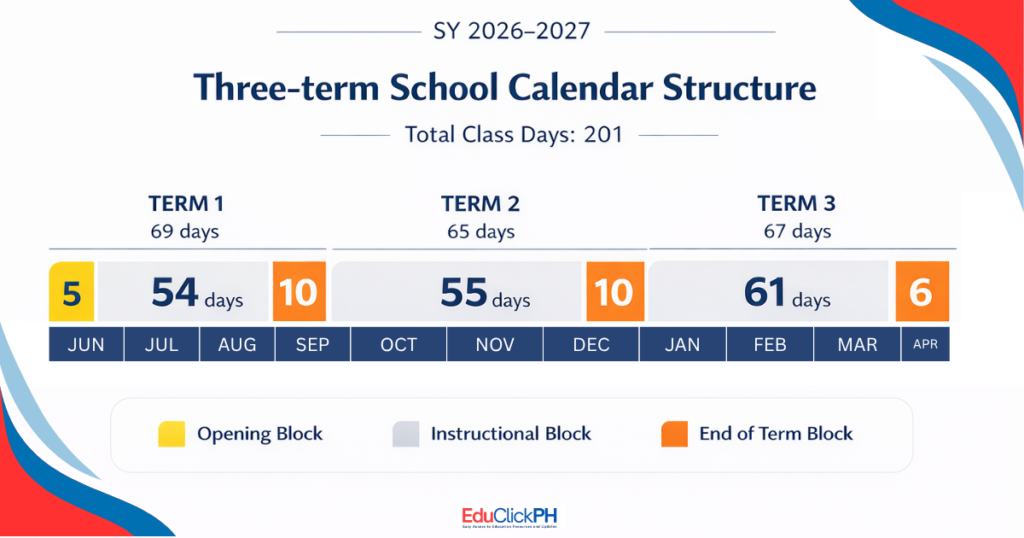
The Department of Education (DepEd), through DepEd Order No. 15, s. 2026, has introduced updated guidelines on classroom assessment, grading, and learner recognition under the K to 12 Basic Education Program. One of the major changes under the revised policy is the establishment of clear provisions for Term Examinations (TEs) across different key stages, aligned with the implementation of the Three-Term School Calendar for School Year 2026–2027.
Under the new guidelines, the structure and number of items for Term Examinations vary depending on the developmental needs and competencies expected of learners at each key stage. The policy aims to ensure that assessments remain age-appropriate, competency-based, and aligned with intended learning outcomes.
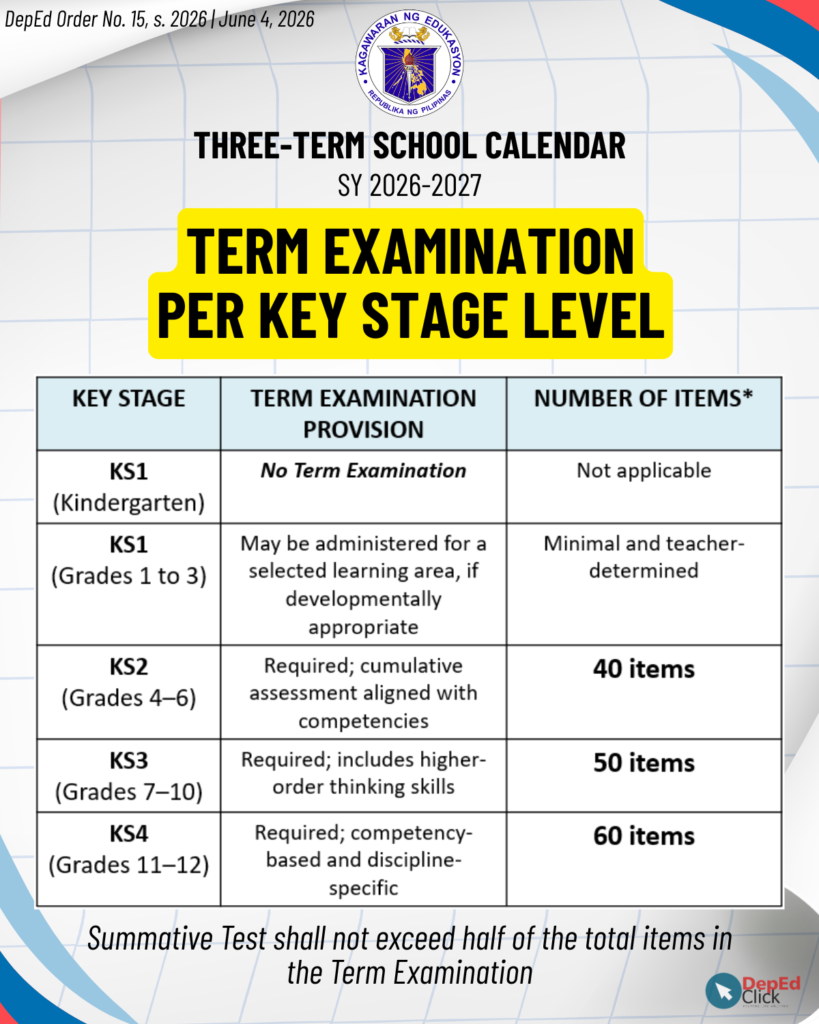
Term Examination Guidelines Per Key Stage
Key Stage 1 (Kindergarten)
Kindergarten learners will not take a Term Examination. Assessment will continue to focus on observation, developmental progress monitoring, and other age-appropriate assessment strategies rather than formal written examinations.
Key Stage 1 (Grades 1–3)
For Grades 1 to 3, a Term Examination may be administered only when developmentally appropriate and only for selected learning areas. The number of items is not fixed and shall be determined by the teacher based on learners’ needs and readiness.
Key Stage 2 (Grades 4–6)
Learners in Grades 4 to 6 are required to take a Term Examination. The examination should serve as a cumulative assessment aligned with the competencies covered during the term. The prescribed maximum number of items is 40.
Key Stage 3 (Grades 7–10)
For Junior High School learners, Term Examinations are also required and should include higher-order thinking skills (HOTS). The prescribed number of items is 50.
Key Stage 4 (Grades 11–12)
Senior High School learners shall take competency-based and discipline-specific Term Examinations. The prescribed number of items is 60.
Important Reminder on Summative Tests
DepEd Order No. 15, s. 2026 also provides guidance on the conduct of Summative Tests (STs). These assessments are administered after approximately fifteen (15) days of instruction and must be aligned with the intended learning competencies.
As a general rule, the number of items in each Summative Test must not exceed one-half of the total number of items prescribed for the corresponding Term Examination. This ensures that assessments remain manageable for learners while still providing valid evidence of learning.
Supporting Meaningful Assessment
The revised assessment framework emphasizes quality over quantity. Rather than focusing solely on memorization, the new guidelines encourage assessments that measure understanding, application, analysis, and other higher-order thinking skills appropriate to each learner’s developmental level.
With these changes, DepEd seeks to ensure that classroom assessments become more learner-centered, competency-based, and responsive to the goals of the MATATAG Agenda and the Three-Term School Calendar.