The Department of Education (DepEd) has issued DepEd Memorandum No. 064, s. 2026, titled “Anticipatory Action, Preparedness, and Protective Measures for the 2026–2027 Super El Niño,” directing schools and education offices nationwide to strengthen their preparedness against extreme heat, water shortages, drought, and other possible effects of the El Niño phenomenon.
Issued on October 26, 2026, the memorandum outlines preventive measures designed to protect learners, teachers, and non-teaching personnel while ensuring that education services can continue safely whenever conditions permit.
The issuance follows an advisory from the Philippine Atmospheric, Geophysical and Astronomical Services Administration (PAGASA), dated October 7, 2026, reporting strong to very strong El Niño conditions in the tropical Pacific that could peak before the end of 2026 and persist until the first half of 2027.
According to DepEd, the anticipated conditions could affect classroom temperatures, drinking water availability, sanitation facilities, electricity supply, school feeding programs, and overall learning conditions.
Rather than waiting for these problems to worsen, DepEd is requiring schools to take preventive action based on their actual risks and local conditions.
1. Schools Must Assess Their Preparedness Against El Niño
One of the main requirements of the memorandum is the conduct of an integrated school-level risk assessment.
School heads, together with their School Disaster Risk Reduction and Management (DRRM) teams, must evaluate potential hazards and identify appropriate preventive measures.
The assessment covers:
- Extreme heat: Classroom temperatures, ventilation, overcrowding, and availability of shaded areas.
- Water supply: Availability of safe drinking water, water storage, toilets, and handwashing facilities.
- Fire safety: Potential fire hazards, electrical problems, and unsafe school facilities.
- Electricity: Possible power interruptions affecting ventilation and essential school services.
- Food security: Possible interruptions to food supplies and school feeding programs.
- Learning continuity: Possible effects on attendance, classroom instruction, and access to learning materials.
Schools are instructed to use the El Niño Risk Assessment Tool for Schools under Annex A of the memorandum.
The original national guidelines required schools to complete their assessments within five calendar days from the issuance of the memorandum.
School heads must also review and update their existing Learning and Service Continuity Plans (LSCPs), school DRRM plans, and emergency communication procedures based on the identified risks.
2. DepEd Introduces the 4H Framework for Learning Arrangements
A major provision of the memorandum is the implementation of the 4H Scenario Continuum, consisting of Hayo, Hinay, Hinga, and Hinto.
The framework provides four levels of learning arrangements according to heat index conditions and the actual situation of schools.
HAYO – Manageable Conditions (Below 27°C)
Regular face-to-face classes may continue.
Schools must maintain proper ventilation, provide access to safe drinking water, allow hydration breaks, and schedule outdoor activities during cooler periods.
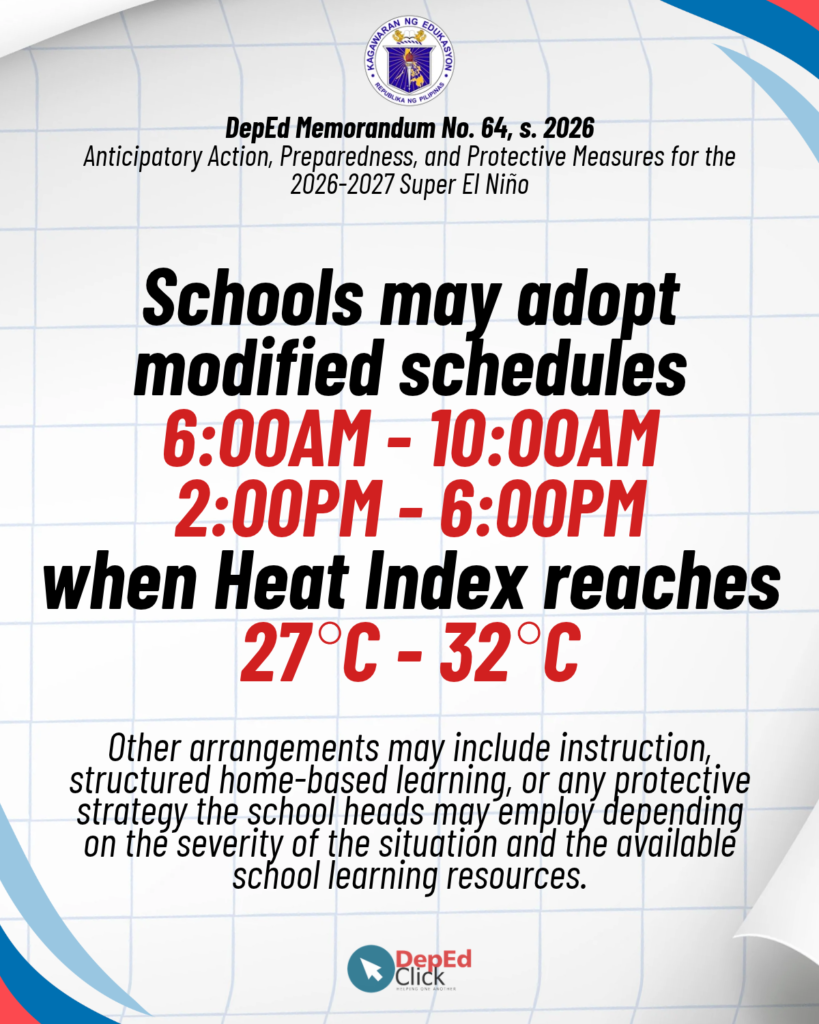
HINAY – Caution (27°C–32°C)
Schools may reduce face-to-face class hours or adopt hybrid and home-based learning arrangements.
Possible modified schedules include 6:00 a.m. to 10:00 a.m. or 2:00 p.m. to 6:00 p.m. These are examples rather than compulsory schedules.
School heads may determine other suitable arrangements depending on local conditions and available resources.
HINGA – Extreme Caution (33°C–41°C)
Face-to-face classes are suspended under this learning continuity level.
However, appropriate learning activities may continue through lighter home-based tasks, printed learning packets, DepEd television or radio resources, and learner well-being check-ins.
Academic requirements should be reduced to avoid placing additional stress on learners.
HINTO – Danger and Extreme Danger (42°C and Above)
Academic activities are suspended, including both face-to-face and home-based learning.
During this level, schools must prioritize the safety and well-being of learners and personnel.
Communication with families, safety monitoring, and necessary support or referrals may continue, but learners should not be required to complete academic tasks.
Importantly, these temperature ranges refer to the heat index, not ordinary air temperature. The heat index considers both temperature and humidity to estimate how hot conditions feel.
3. Extreme Heat Does Not Automatically Mean Class Suspension
DepEd emphasizes that extreme heat conditions do not automatically require the suspension of classes in every school.
School authorities must consider actual classroom conditions, ventilation, availability of drinking water, heat exposure, and the circumstances of learners and teachers.
However, school authorities may suspend classes even before the highest heat index threshold is reached if prevailing conditions become unbearable or unsafe.
School heads must coordinate school-level suspension decisions and appropriate alternative learning arrangements with the Schools Division Superintendent, consistent with applicable DepEd policies.
The memorandum must be implemented alongside DepEd Order No. 022, s. 2024, on class and work suspension during disasters and emergencies, and DepEd Order No. 014, s. 2026, on learning continuity in emergencies.
4. Schools Must Monitor Classroom Heat Index Three Times Daily
To support informed decisions, schools are directed to monitor classroom temperature and relative humidity using thermometers with hygrometers or appropriate monitoring devices.
Under Annex B of the memorandum, temperature and humidity readings must be recorded at least three times daily:
- 8:00 a.m. – Morning reading
- 12:00 noon – Midday reading
- 2:00 p.m. – Afternoon reading
Schools must use the official PAGASA Heat Index Chart to determine the corresponding heat index.
The monitoring data must be submitted daily to DepEd’s Disaster Risk Reduction and Management Service (DRRMS) through the designated reporting channel.
These readings will help schools determine whether regular classes can continue safely or whether protective adjustments are necessary.
5. Schools Must Strengthen Health and Safety Measures
The memorandum also directs schools to implement practical measures to protect learners and personnel against heat-related illnesses.
These include ensuring adequate classroom ventilation, identifying cooler resting areas, providing safe drinking water, and allowing regular hydration opportunities.
Physically demanding activities, outdoor assemblies, and sports activities must be adjusted, rescheduled, relocated, or temporarily discontinued when conditions become unsafe.
Schools must also maintain first-aid supplies, emergency contact information, and appropriate procedures for responding to heat-related illnesses.
Special consideration must be given to learners and personnel who may be more vulnerable to extreme heat, including those who require additional health-related accommodations.
6. Wearing Light and Comfortable Clothing May Be Allowed
Recognizing the discomfort caused by excessive heat, DepEd allows reasonable flexibility in school and office attire.
Teachers, school personnel, and learners may be permitted to wear light, breathable, and comfortable clothing, including authorized alternative uniforms.
Previously issued DepEd collared shirts used during official activities may also be allowed, subject to existing standards of professionalism, decency, and proper decorum.
The policy aims to reduce unnecessary heat exposure while maintaining appropriate school attire standards.
7. Learning Must Continue Safely Without Additional Financial Burden on Families
DepEd directs schools to prepare alternative learning arrangements in anticipation of possible disruptions.
These may include printed Learning Activity Sheets (LAS), learning packets, offline materials, authorized digital learning resources, and educational television or radio programs.
Teachers are also expected to prioritize essential learning competencies, particularly literacy, numeracy, and other foundational skills.
Flexible lesson pacing and reduced academic requirements may be implemented depending on the applicable 4H level.
The memorandum explicitly prohibits schools from requiring families to purchase devices, internet connectivity, printed learning materials, drinking water, cooling equipment, or special clothing as a condition for instruction or assessment.
Schools must provide feasible no-cost alternatives whenever necessary.
DepEd also calls for appropriate learner well-being activities, psychosocial support, and learning recovery interventions following disruptions.
8. Water Security, Fire Prevention, and School Feeding Must Be Prioritized
Aside from classroom heat, the memorandum addresses other essential school services.
Schools must assess the reliability and safety of their water sources and ensure that water conservation measures do not compromise drinking water, sanitation, handwashing, or food preparation.
The memorandum also allows the procurement of water filtration kits, subject to applicable government procurement requirements.
Fire safety inspections must be strengthened, particularly in areas with dry vegetation, combustible materials, unsafe electrical connections, and obstructed emergency exits.
Open burning and other unsafe practices that increase fire hazards are prohibited. Learners must not be assigned hazardous firefighting, electrical repair, or emergency-response duties.
For schools implementing the School-Based Feeding Program (SBFP), contingency arrangements must be prepared to address possible disruptions in food availability, pricing, delivery, and storage.
These arrangements may include alternative food suppliers, adjusted menus, and coordinated assistance from local government units and other partners, while maintaining nutrition and food safety standards.
9. School Funds May Be Used for Authorized Preparedness Measures
The memorandum recognizes that schools may need additional resources to implement protective measures.
Available School Maintenance and Other Operating Expenses (MOOE) may be used for eligible and necessary preparedness activities, subject to existing guidelines, fund availability, and government financial rules.
Schools may also coordinate with their respective Schools Division Offices, local government units, and other authorized partners for possible assistance.
Regional and division offices may utilize eligible Disaster Preparedness and Response Program funds in accordance with applicable rules.
However, the memorandum does not authorize unrestricted spending. All expenditures must comply with existing budgeting, procurement, accounting, and auditing requirements.
10. Parents, Teachers, and Communities Have Important Roles
DepEd emphasizes the importance of coordinated action among school officials, teachers, parents, learners, and local government units.
School heads must ensure that families receive timely information about heat advisories, changes in class schedules, possible suspensions, and alternative learning arrangements.
Teachers are expected to help learners understand heat safety, hydration, water conservation, climate change adaptation, and fire prevention.
Schools are also encouraged to strengthen environmental education through classroom discussions and activities involving the Youth for Environment in Schools Organization (YES-O).
Parents and guardians, meanwhile, are encouraged to monitor official school announcements and help children observe appropriate health and safety practices at home.
How Long Will the Memorandum Remain in Effect?
DepEd Memorandum No. 064, s. 2026, will remain in effect until PAGASA issues its final advisory announcing the end of the 2026–2027 El Niño, unless the memorandum is amended, revoked, or superseded by another DepEd issuance.
Schools must continue monitoring official advisories and adjusting their preparedness measures according to prevailing conditions.
Final Reminder
The 2026–2027 Super El Niño presents potential challenges to the Philippine education system, particularly for schools with limited water supplies, inadequate ventilation, and insufficient resources.
Through DepEd Memorandum No. 064, s. 2026, the Department of Education is emphasizing that preparedness must begin before extreme conditions place learners and school personnel at risk.
The central message of the memorandum is clear: protecting the health, safety, and well-being of learners and education personnel must remain the priority, while learning continuity measures should be implemented only when conditions allow them to be carried out safely.