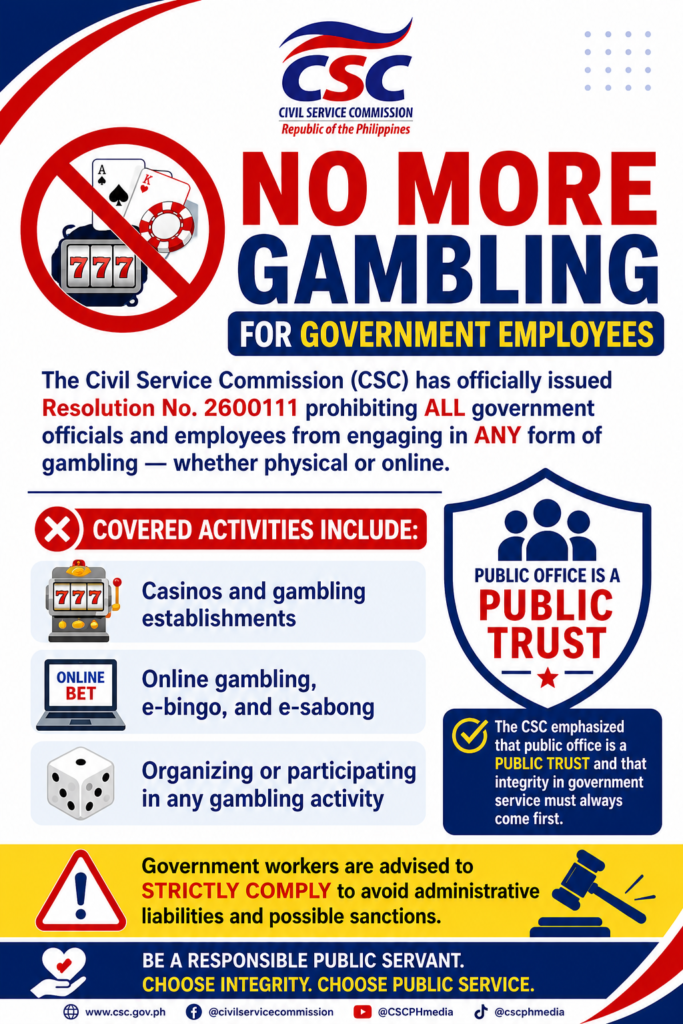
The Civil Service Commission (CSC) has officially strengthened its commitment to integrity and professionalism in public service through CSC Resolution No. 2600111, which prohibits government officials and employees from engaging in any form of gambling.
The resolution covers both physical and online gambling activities, reinforcing the constitutional principle that public office is a public trust.
With the increasing accessibility of online betting platforms, the CSC emphasized the importance of maintaining ethical conduct and accountability among public servants.
What is CSC Resolution No. 2600111?
CSC Resolution No. 2600111 is a policy issued by the Civil Service Commission that bans government employees from participating in gambling activities regardless of:
- Location
- Time
- Platform used
- Type of gambling activity
The prohibition applies to all government officials and employees in:
- National government agencies
- Local government units (LGUs)
- Government-owned and controlled corporations (GOCCs)
- State universities and colleges (SUCs)
- Other public institutions and offices
Because of this resolution, government workers are expected to strictly avoid all forms of gambling participation.
Covered Gambling Activities
Under the resolution, prohibited acts include:
🎰 Casinos and Gambling Establishments
Government employees are prohibited from:
- Entering casinos
- Staying inside gambling establishments
- Participating in betting activities in physical venues
💻 Online Gambling and Betting Platforms
The ban also includes online activities such as:
- Online casinos
- E-bingo
- E-sabong
- Sports betting
- Digital gambling applications and websites
This provision highlights the CSC’s recognition of the growing popularity of online gambling platforms.
🎲 Organizing or Participating in Gambling Activities
Public servants are likewise prohibited from:
- Organizing gambling activities
- Facilitating betting operations
- Participating in informal gambling activities
Even indirect participation may lead to administrative liabilities.
Why the CSC Implemented the Ban
The Civil Service Commission explained that the policy aims to:
- Protect the integrity of public service
- Promote professionalism among government employees
- Prevent conflicts of interest
- Maintain public trust in government institutions
According to the CSC, public servants must always uphold ethical behavior and demonstrate accountability both inside and outside government offices.
Public Office is a Public Trust
One of the strongest messages emphasized in the resolution is:
“Public office is a public trust.”
This principle reminds government employees that their actions reflect the credibility and integrity of the institutions they serve.
Because of this, government workers are expected to avoid activities that may:
- Damage public confidence
- Affect work performance
- Create ethical concerns
- Compromise professionalism
Possible Administrative Liabilities
Government employees who violate the resolution may face:
- Administrative sanctions
- Disciplinary actions
- Possible suspension or penalties depending on the offense
Therefore, all public servants are strongly encouraged to comply with the policy.
Impact on Government Employees
The resolution affects millions of government workers nationwide, including:
- Teachers
- Administrative personnel
- Uniformed personnel
- Government agency employees
- Local government workers
As online gambling becomes more accessible, the CSC seeks to strengthen discipline and accountability within the public sector.
Strengthening Integrity in Public Service
The policy reflects the government’s broader effort to:
- Promote ethical governance
- Encourage responsible public service
- Strengthen professionalism in government institutions
By discouraging gambling activities, the CSC hopes to foster a culture of integrity, discipline, and accountability among civil servants.
Through CSC Resolution No. 2600111, the Civil Service Commission has formally prohibited government employees from engaging in any form of gambling, whether physical or online.
The policy serves as a reminder that government workers must uphold professionalism, integrity, and public trust at all times. As the resolution takes effect, public servants are encouraged to strictly comply to avoid administrative liabilities and maintain the dignity of public service.