Teaching a child how to read becomes easier when the lesson is simple, clear, and repetitive. For early readers, one of the most effective ways to build reading confidence is through word families. These patterns help children notice how words are formed, how syllables work, and how sounds repeat. Because of this, many teachers and parents use Filipino word family charts for kids as part of early reading practice.
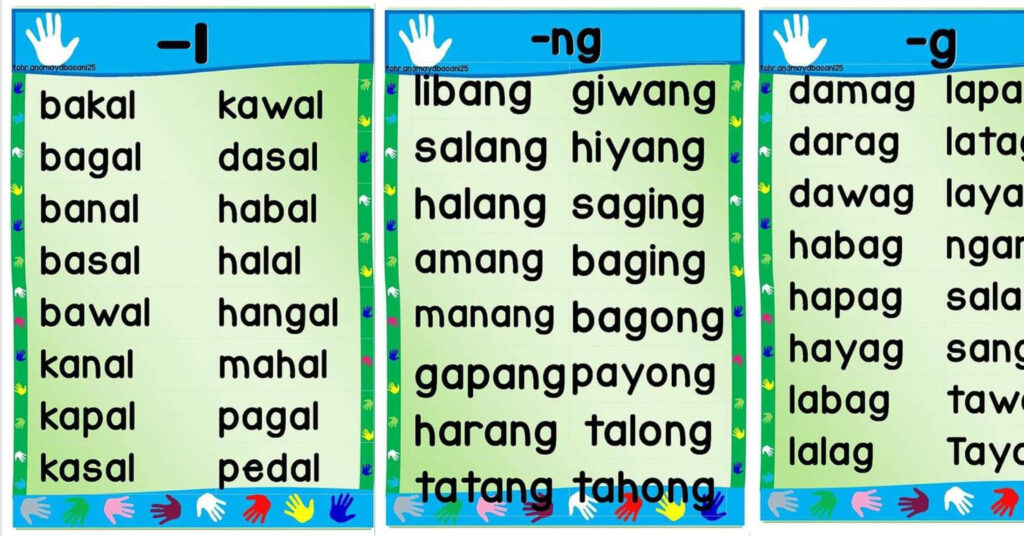
The reading materials in your sample focus on Filipino word endings such as -l, -ng, and -g. These printable charts give children a chance to read several words that share similar sound patterns. This type of practice is very helpful for beginning readers because it trains the eyes and ears to spot common parts in words. When children can recognize these patterns, reading becomes easier, faster, and more meaningful.
These materials are useful for preschool learners, kindergarten pupils, Grade 1 students, and children in remedial reading. They are also helpful for parents, tutors, and teachers who want easy-to-use reading resources. Since the words are grouped by similar endings, children can focus on one pattern at a time. This makes the lesson less confusing and more effective.
If you plan to post educational printables on your website, Filipino word family charts are a strong choice. They are simple, practical, and valuable for early literacy development. They also work well for daily reading drills, classroom review, and home practice.
What Are Filipino Word Family Charts?
Filipino word family charts are reading materials that group words according to a shared ending sound or spelling pattern. Instead of showing random vocabulary words, these charts organize words in a way that helps children notice common structures. For example, children may read sets of words ending in -l, -ng, or -g.
This approach is effective because early readers often learn better through patterns. When children see several words that look and sound alike, they begin to understand how words are built. They do not need to treat every word as something completely new. Instead, they can use what they already know to read the next word.
For example, if a child reads bakal, banal, kawal, mahal, and kasal, the child starts to notice the repeating ending sound. In the same way, reading words like libang, salang, halang, manang, and bagong helps the learner recognize another common pattern. This repeated exposure supports both decoding and word recognition.
Why Word Families Matter in Early Reading
Word families are important because they make reading more manageable for young learners. A child who understands one pattern can often read many related words. This creates a sense of progress and reduces reading frustration.
Early readers need many chances to notice how letters and sounds work together. Word family activities provide that practice in a simple way. Instead of memorizing words one by one, children learn to observe patterns. This skill is valuable because it helps them decode unfamiliar words later on.
Word family practice also improves confidence. When a child reads a page of related words and begins to notice the pattern, the child feels more capable. That confidence matters. Children who feel successful are more likely to keep practicing and enjoy reading.
In Filipino reading instruction, patterned words are especially helpful because many words follow clear syllable and sound rules. This makes word family charts a practical and effective tool for beginning readers.
Why These Reading Materials Are Helpful
The word charts in your samples are useful because they are simple, organized, and easy to read. Each chart focuses on a specific ending pattern, which helps children stay focused on one sound group at a time. This clear structure is important for young learners who are still building their reading foundation.
The large text also makes the charts easy to see and follow. Children can point to each word as they read. This supports tracking and visual recognition. Since the words are arranged neatly, the page does not feel crowded or overwhelming.
Another advantage is repetition. Repetition helps young learners remember what they read. When children see several words with the same ending, they start to recognize the pattern more quickly. Over time, this helps them read with better fluency and less hesitation.
These materials are also flexible. They can be used for oral reading, group drills, spelling practice, word recognition activities, and review sessions. That makes them useful in both school and home settings.
Filipino Word Family Charts for Kids