
Learning to read becomes easier when children use materials that are clear, simple, and easy to follow. For young learners, practice works best when reading lessons focus on patterns. That is why consonant cluster and diphthong reading materials in Filipino are very helpful for early reading development.
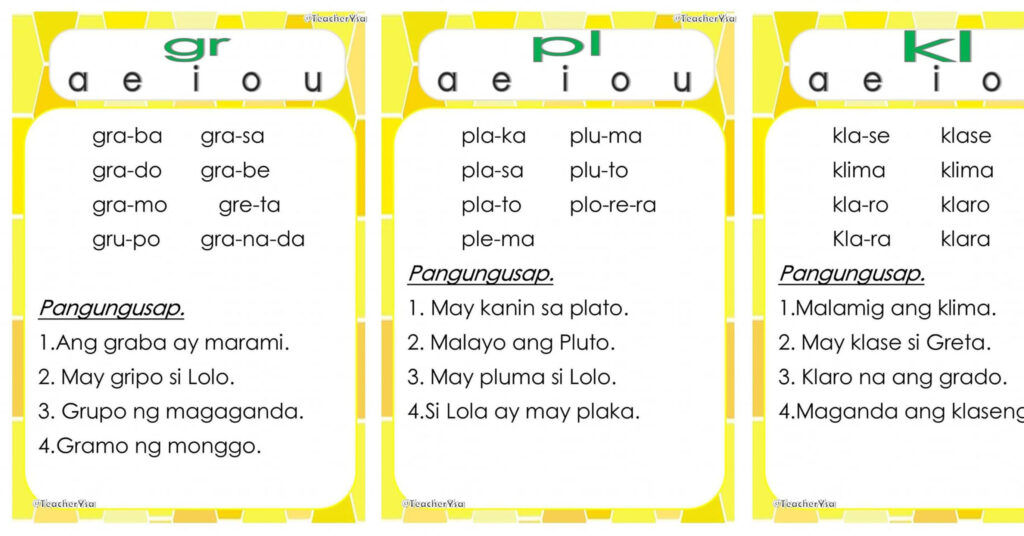
The materials in your sample introduce children to Filipino words with consonant clusters such as gr, pl, and kl. These word patterns help children learn how blended consonant sounds work inside real words. Instead of reading letters one by one without meaning, children begin to see sound patterns and word structure. As a result, they become more confident and more accurate readers.
These reading materials are useful for preschool learners, kindergarten pupils, Grade 1 students, and children who need extra reading support. They are also helpful for parents, teachers, tutors, and homeschool families who want easy printable materials for daily reading practice.
Because the worksheets include word examples and simple sentences, children do not only practice reading isolated words. They also learn how these words are used in real sentence form. This improves reading fluency, word recognition, pronunciation, and basic comprehension at the same time.
If you are planning to post educational resources on your website, this type of reading material is a strong choice. It is practical, beginner-friendly, and valuable for Filipino reading instruction.
What Are Consonant Clusters and Diphthongs?
A consonant cluster happens when two consonants appear together in a word and keep their own sounds. In Filipino reading materials, examples include gr, pl, and kl in words such as graba, grado, plato, pluma, klima, and klase.
A diphthong happens when two vowel sounds glide together in one syllable. Even though your sample pages focus more on consonant clusters, cluster and diphthong lessons are often taught together because both help children understand sound patterns and word formation.
These concepts are important in reading because they teach children to recognize groups of letters that work together. Once children understand these sound patterns, they can read similar words more easily. This makes reading practice smoother and less stressful.
Why These Reading Skills Matter
Children need more than simple letter recognition to become strong readers. They also need to understand how sounds combine to form words. This is where consonant clusters and diphthongs become very useful.
When children practice these patterns, they improve decoding skills. Decoding means reading words by connecting letters and sounds correctly. A child who understands gr in graba or pl in plato is better prepared to read new words with the same pattern.
This kind of practice also helps with pronunciation. Some children can identify letters, but they still struggle to say clustered sounds smoothly. With regular practice, they begin to pronounce words more naturally.
In addition, pattern-based reading builds confidence. Children feel more successful when they can read several related words correctly. That success motivates them to continue learning.
Why These Reading Materials Are Effective
The worksheets you shared are effective because they are simple and focused. Each page highlights one cluster at a time, such as gr, pl, or kl. This clear structure helps children focus on one pattern without distraction.
The materials also move in a helpful sequence. First, children read word examples. Then, they read short sentences that use the same pattern. This step-by-step structure is excellent for beginning readers because it supports gradual learning.
The words are easy to see, easy to repeat, and easy to practice. The sentences are also short and direct. This matters because young children learn better when the reading task feels manageable. Long and difficult texts can feel overwhelming, but short pattern-based reading makes practice easier.
Because of this structure, these materials work well for classroom drills, one-on-one tutoring, homework, and home reading sessions.
Consonant Cluster and Diphthong